
Eduardo Arroyo [NO.MAD] - Levene House
Edición Digital
 Formato PDF - 28 páginas
San Lorenzo de El Escorial, Madrid, Spain 2002-2006
INHABITING THE ANTI-FOREST, USEFUL REGULATIONS
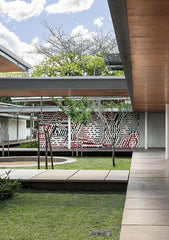
For the concept of this home, we asked ourselves whether we were capable of building something while maintaining the utmost respect for the natural surroundings, avoiding speaking about sustainability, alternative energy or ecology as a veneer for modernity and political correctness. Perhaps it was ultimately a question of making the most of the qualities of the given natural environment and having a minimum impact on them. We thought that a good way to start might be to adapt the volumetric line of the building to existing forest, leaving the plantation to choose the way it would be experienced. As the starting point for this process, we identified the clusters of trees that work together in the forest while we dared to call everything that lies outside them the 'anti-forest' or a construction-susceptible void, without having to remove any trees. We generated a flat geometry on top of this void to avoid the trunks and take the heights from the existing ground level and the slopes of the roof planes permitted by the by-laws. This operation appeared to be an immensely complex part of the
![Eduardo Arroyo [NO.MAD] - Casa Levene](http://cdn.shopify.com/s/files/1/1380/4487/files/74_Casa_Levene_1024x1024.jpg?v=1525776242)