

TEAM
EL CROQUIS HEADQUARTERS
EDITORS AND DIRECTORS
Fernando Márquez Cecilia y Richard Levene
architects

LAYOUT
Richard Levene
EDITORIAL STAFF
Liliana C. Obal
GRAPHIC PRODUCTION
Cristina Poveda
PHOTOGRAPHS
Hisao Suzuki y Jesús Granada
TRANSLATION
Jamie Benyei
Liliana C. Obal
ADMINISTRATION
Mariano de la Cruz y Ana González
DISTRIBUTION
Ana Pérez Castellanos
SUBSCRIPTIONS
Yolanda Muela


SECRETARIAL STAFF
Fabiola Muela

ECOMMERCE
Dani Quesada
DESIGN AND PROCUTION PREPRESS AND PRINTING BINDING
EL CROQUIS EDITORIAL Gráficas Palermo y DLH Encuadernación Ramos
Contact
Av. de los Reyes Católicos, 9.
E-28280 El Escorial. Madrid. España
Phone
EL CROQUIS
tel.: 34-918969410
DISTRIBUTION
tel.: 34-918969413
.
EL CROQUIS HEADQUARTERS

Architecs: Richard Levene & Fernando Márquez Cecilia
El Escorial, Madrid. 1995/1998
The building is 45 km from Madrid on the avenue linking the San Lorenzo Monastery to the El Escorial township. The site, part of a colony of single family dwellings alongside the Casita del Príncipe Gardens, is divided into two allotments, one of which is occupied by a two-storey house built in the local style. Initially we decided to only work on the free allotment, leaving the construction of a Post-graduate Lecturing area for a later stage. Given the residential nature of the suburb &mdashtwo-storey constructions with sloping roofs throughout&mdashwe chose to minimise the constructed volume above ground level, interpreting the plane of the land with a geometry that would generate inhabitable spaces underneath while reducing the impact of the construction.

The municipal imposition of a sloping roof initially seemed to be a serious handicap to the rotundity of the two prismatic units holding the Publishing House and the Architecture Gallery, originally designed with flat roofs. With the simple benefit of time, however, this regulation became the leitmotiv for a restless volumetry that was gradually set in motion: the two containers sank deeper into the ground, displacing the soil little by little, slowly rusting until the final instant became frozen. The two emerging prisms, ultimately given a sort of flat sloping roof, thus rest on a series of inclined planes in corten steel and laminated glass which in turn move towards the edge of two abstract granite fluids that descend parallel to the transversal direction of the site, stitching the artificial embankment topography and underscoring the pedestrian and service entrance paths. Meanwhile, the idiosyncrasy of the client (ourselves) with respect to the indetermination and ambiguity of uses, desires and priorities which we tried to define intuitively, acted as a liberating factor in the sense that we were able to question the needs programme, keep it open, not compartmentalise spaces at each level and invent new uses in the course of the long design and execution process.

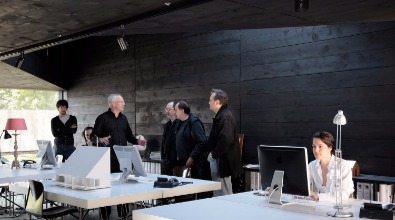
The final programme is developed in two buildings laid in an L arrangement for optimum orientation. They are linked on the ground floor, closed to the traffic on the avenue and open to views over the garden. Management, editorial and production occupy the unit set parallel to the avenue. The administration and sales functions are inserted in a second unit above the Gallery, which occupies the entire ground floor along with a small bookshop and a storage and service zone, serving as a nexus between the two units. The Gallery opens onto the garden through large display windows that extend the space outwards, enabling it to be included as an outdoor exhibition area. In both units we create an interior void that bonds the spaces on the three floors visually, thus producing agile communication between each department.

The opaque faces of these prisms are coated in Roman travertine marble and iroko wood, their facades opening onto the garden with glazing &mdashtransparent in the Gallery and translucent in the Publishing House&mdash which nuances the light or outlines certain perspectives, depending on the sunlight and the desired luminosity. The glazing procedure includes lined film normally used in poster production which, inserted between the double panes of glass and etched with black bands in different thickness, mitigates the green tone of the glass. The treatment of the two interior spaces differentiates the wall finishes in the two units &mdashbeech panelling in the long block and extradosed plasterboard in the short block&mdash, while iroko flooring is used throughout.
