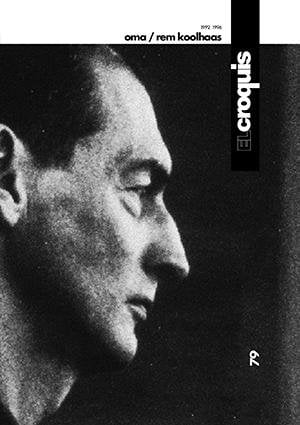
N. 79 OMA / Rem Koolhaas (Digital Archive)
Edición Digital

También disponible en la Biblioteca Digital
Also available at our Digital Library
Content
Complete digitization of number 79.
Published in 1996, the monograph follows the trajectory of OMA / Rem Koolhaas between 1992 and 1996.
Essays
A Conversation with Rem Koolhaas
Alejandro Zaera
Recent Koolhaas
Jeffrey Kipnis
Works
Congrexpo
Lille, France, 1990-1994
Kunsthal in Rotterdam
Rotterdam, Netherlands , 1987-1992
A Dutch House
Netherlands, 1992-1993
Projects
Two Ubraries for Jussieu
Paris, France, 1992
Educatorium en la Universidad de Utrecht
Utrecht, Holanda, 1994/1995-1997
Maison à Burdeos
Floirac, France, 1994/1996-
Cardiff Bay Opera House
Wales, Reino Unido,
Extension of the Tate Gallery
London, UK, 1994-1995
Miami Performing Arts Center
Florida, USA, 1994
Hypo-Theatiner-Zentrum at the Gablerhaus
Munich, Germany, 1994/1995
Propuestas Urbanas
Yokohama Urban Ring
Yokohama, Japan, 1992
Service Tunnel in The Hague
Netherlands, 1992/1995-2000
New Seoul International Airpot
Korea, 1995
Proyecto de Remodelación Urbana para Almere
Almere, Netherlands, 1994-1995
OMA / Rem Koolhaas
Rem Koolhaas was born in 1944. After having lived in Indonesia between 1952 and 1956, he settled in Amsterdam as a journalist for the Haagse Post and as a film screenplay writer, before leaving for London to study architecture at the Architectural Association School. Two theoretical projects come from this period: The Berlín wall as architecture (1970) and Exodus, or the voluntary prisoners of architecture (1972).
A scholarship obtained in 1972 allowed him to stay in the United States, where, fascinated by New York, he started to analyze the impact of metropolitan culture on architecture and published Delirious New York, a retroactive manifesto for Manhattan.
At this stage, Rem Koolhaas wanted to progress from theory to practical application and decided to return to Europe. In London in 1975, he created, with Elia and Zoe Zenghelis and Madelon Vriesendorp, the Office for Metropolitan Architecture (OMA), whose objectives were the definition of new types of relations -theoretical as well as practica!- between architecture and the contemporary cultural situation. Since 1978, several orders in Holland, such as the Extension of The Hague's Parliament, led him to open an agency in Rotterdam which was to henceforth centralize OMA's activities. At the same time, he created the Grosztstadt Foundation, an independent structure controlling the cultural activities of the agency, such as exhibitions and publications. Current work includes the edition of the book OMA: S, M, L, XL, released in 1996.

Photograph by Robin Holland