It’s about Architecture, but it’s not about Architecture
Mirko Zardini
DOWNLOAD THE FULL INTERVIEW IN PDF
Bijoy, it is just five years since your last El Croquis, yet that period has seen major changes for your studio, with new offices and projects in Italy, Japan, and France. Previously presented projects have now been built in India. Your main office in India has moved from Alibag to Mumbai. And Mumbai itself is experiencing a moment of rapid change. The urban condition is drastically different from even just a few years ago.
Mumbai’s rate of re-development over the past five years has been substantial, and it will be even greater in ten years from now. A lot of land has been cleared of 'informal' settlements to build high-rise towers. In order to build, the developer has had to rehouse all the previous inhabitants who have been displaced. It’s called a Slum Rehabilitation Scheme. It’s a political system that is re-shaping and re-defining the greater metropolitan region of Mumbai.
But sitting here in Saat Rasta, your new office in Mumbai, there is a different perception of the urban condition. The project involves the transformation of an old factory, an infill made up of a cluster of courtyards, allowing light to penetrate deep into its floor plate. You have maintained the original wall that faces the street, highlighting the stark difference between the city and the interior. And the vegetation, which can often be an afterthought, plays a significant role in shaping the atmosphere. The plants begin to almost take over the space, in which the architecture starts acting more as an organizational mechanism. It is still apparent, but softened. How have you understood this typological change in Mumbai?
Mumbai’s shift from 'informal' settlements to high-rise towers is due to an exponential increase in the population, with large numbers of people moving into urban centres and creating a demand for density. However, this building strategy neglects the relationship with the ground, and with elements like water, air and light. I understand Saat Rasta more as an armature or a manifold where the space remains open to absorb these elements and include them in the liminal spaces between rooms. Similarly, the relationship can be included in a vertical manner, by increasing the amount of surface area exposed to the elements, which can absorb and amplify this potential.
What does it mean for a project to be open? To change, evolve, mutate, percolate...?
What makes a city are the in-between spaces&mdash the gaps and open spaces between components which define and give them intention. They allow them to breathe in the sense that they become mechanisms that let the building spread out into the landscape and vice-versa. The building code determines the dimensions of these in-between spaces, but there is an opportunity to define their qualitative aspects.
In your projects, special attention is paid to the outside space. Solo House, Kasauli Houses, Ganga Maki Textile Studio and even Saat Rasta Houses with its courtyards are just some examples. It is evident that the architecture is framing the outside spaces, which seem just as important as the building itself.
While working on Solo House, I was going through a break in my family. The project came to reflect this shift, by showing a house cut straight down the middle and pulled apart. The cut, marked by a big circle filled with water, becomes an interstitial crux between the homes. The strategy was to tap into an existing water source, found slightly higher up on the slope. This is the point of origin that takes advantage of the site’s orientation; collecting water by following the gradient of the slope.
The idea behind this in-between space was to be a place of rest, where travellers passing through could find water, fire, some blankets, a semi-covered place to rest and leave the next day. So, by collecting the water, it becomes the basis for the existence of these structures. This water space takes on qualities of being suspended between interior and exterior.
Water has been a recurring element in many of your earlier projects and still holds a place in your current projects. Where does this preoccupation with water as both an architectural and atmospheric element stem from?
Without water, I am not grounded. Even in its absence there is an understanding of how it might have once occupied and shaped a space. This is intrinsic to my architecture. One of the first projects I designed in architecture school was a playground. It was a stepped water tank near my house with a dimension that I cannot recall, but it was something I played in as a kid. The designated site had no water. So, I tried to replicate the same conditions as my childhood playground, and I managed to fit some of those elements into the space. One of them was water. Recently, someone told me that the first project you do at architecture school is the project that you do for the rest of your life. My first project as a student had to do with water, and it has never left me.
While the ideas behind your architecture are consistently interrogated and incorporated in your studio’s work, the 'how' seems to be in flux. In the recent years, the operations and organization of your office have changed substantially. What has caused this change in the office’s practices and operations?
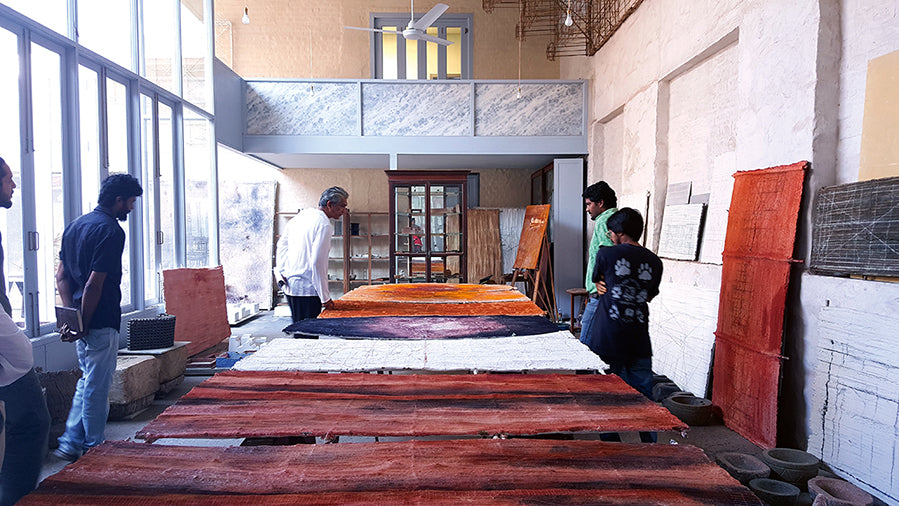
I would say it has not changed, but evolved. Before the first El Croquis, everything was in-house. It was a controlled environment, but I had to take care of a lot of the managerial tasks while simultaneously looking after the building site, running the studio, meeting with the clients and managing a team of 250 people. Many of the artisans had arrived at a place, particularly the carpenters, where a great economic demand emerged for them to go out into the field and work for others. Once they left, the studio’s ecosystem collapsed. That was in 2013, just before the time I spent at the Canadian Centre for Architecture (CCA), where I worked on the Rooms You May Have Missed exhibition, in 2014. And the Ganga Maki Textile Studio in Dehradun, India, as an alternative, was built with brick, stone and lime due to the lack of carpenters. The project finds a way to execute an architecture with the same spirit, but without relying on carpentry as an essence of its success. All the frames and the structure are done in stone; the construction process is not dissimilar from the way you would make a timber joint.
What was important was that the studio began to open up, and I was now working in a more dynamic, open field, with diverse groups from different geographic regions, both in India and abroad. One important collaborator was Ruedi Krebs, a lime and stone master from Switzerland, who has a deep understanding and expertise in historical building practices. He came to the Ganga Maki textile studio and camped on site for 3 months, transferring his knowledge to thirty young workers from West Bengal, who have become adept in working with lime. He did this out of his own volition, without wanting any compensation. A whole new infrastructure was built.
Keep reading the full PDF interview for free