

Fearlessness of the Familiar. Bernardo Bader in Conversation with Arno Brandlhuber and Olaf Grawert
Arno Brandlhuber y Olaf Grawert
DOWNLOAD THE FULL INTERVIEW IN PDF
"Gesellschaft (society) derives from Gesellen (apprentice craftsman), someone who is allowed to be a part of this specific society. It is therefore a term that comes exclusively from the craft tradition and the apprentice who had the right to join the master at his bench. But this was always a temporary form of togetherness. The concept of Gemeinschaft (community) goes beyond that. You have something in common; you are equally entitled.
The way of thinking in a society is imbued with a strong sense of individuality that says, ‘I can join something in accordance with my ideas and some of my wishes, but I can also leave again. I don’t need to have something in common with it, or conform to it.’ From this perspective, we must ask ourselves how we can enrich the relationship between the individual in society and the community."
Jens Badura, Cultural Philosopher in Architecting after Politics
(Brandlhuber+ and Christopher Roth, 2018)
(Brandlhuber+ and Christopher Roth, 2018)
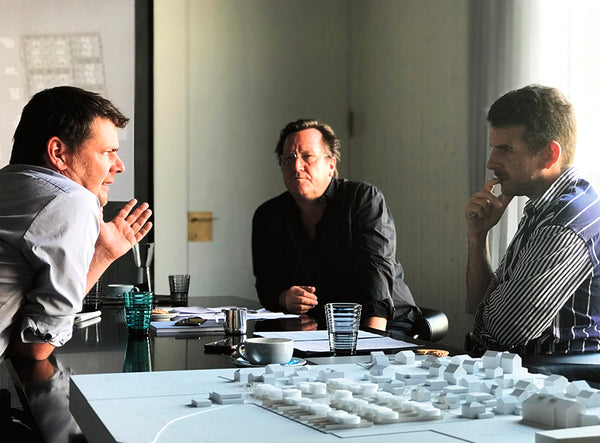
Arno Brandlhuber: I want to start with this quote from Jens Badura and the distinction between society and community &mdashwhich comes from the craft tradition&mdash because I think that traditional crafts, the crafts that are learned and carried on, and also the social and spatial context, play an important role in your work. I would also like to talk about the temporal role of the apprentice in society and the community. How do you reflect these issues in your work?
Bernardo Bader: Building in the countryside is part of my everyday architectural life. It is how I got into the discipline. Of course, one quickly realises that architecture is not an individual achievement, and that it is inextricably linked to the place and the human being. I was trained accordingly. I spent two days a week studying in Innsbruck (Tyrol) and the rest of the time at home. Early on, I started building with friends and craftsmen, and I learned to regard architecture as a community discipline. Looking back, I can say that this dual education and working style became both a guiding method and a conceptual base: a strong affinity with craftsmanship.
But the perfection of craftsmanship is not my main concern. I realized relatively quickly that craftsmanship can be used conceptually and methodically. Working together with craftsmen, we aim to establish a common theme that pulls things together. I don’t see myself as a master and the others as apprentices, but the process does need someone who brings together all the individual pieces: the architect. Building is a process that everyone participates in.
Olaf Grawert: That is particularly evident in the Salgenreute Chapel, which you describe as a place where one can feel that people came together as a community to help. It is also something that Jens Badura addresses in his discussion on society and the commons. He explains that the commons are accessible only to the community from which they emerge. This approach can also be applied to architecture. What happens when architecture opens up more to the community than to society, simply because the latter is not a part of it? Isn’t this kind of architecture, which focuses on a specific community, acceptance and understanding, left wanting in terms of international significance?